
Inside DEI - Pedro Sousa
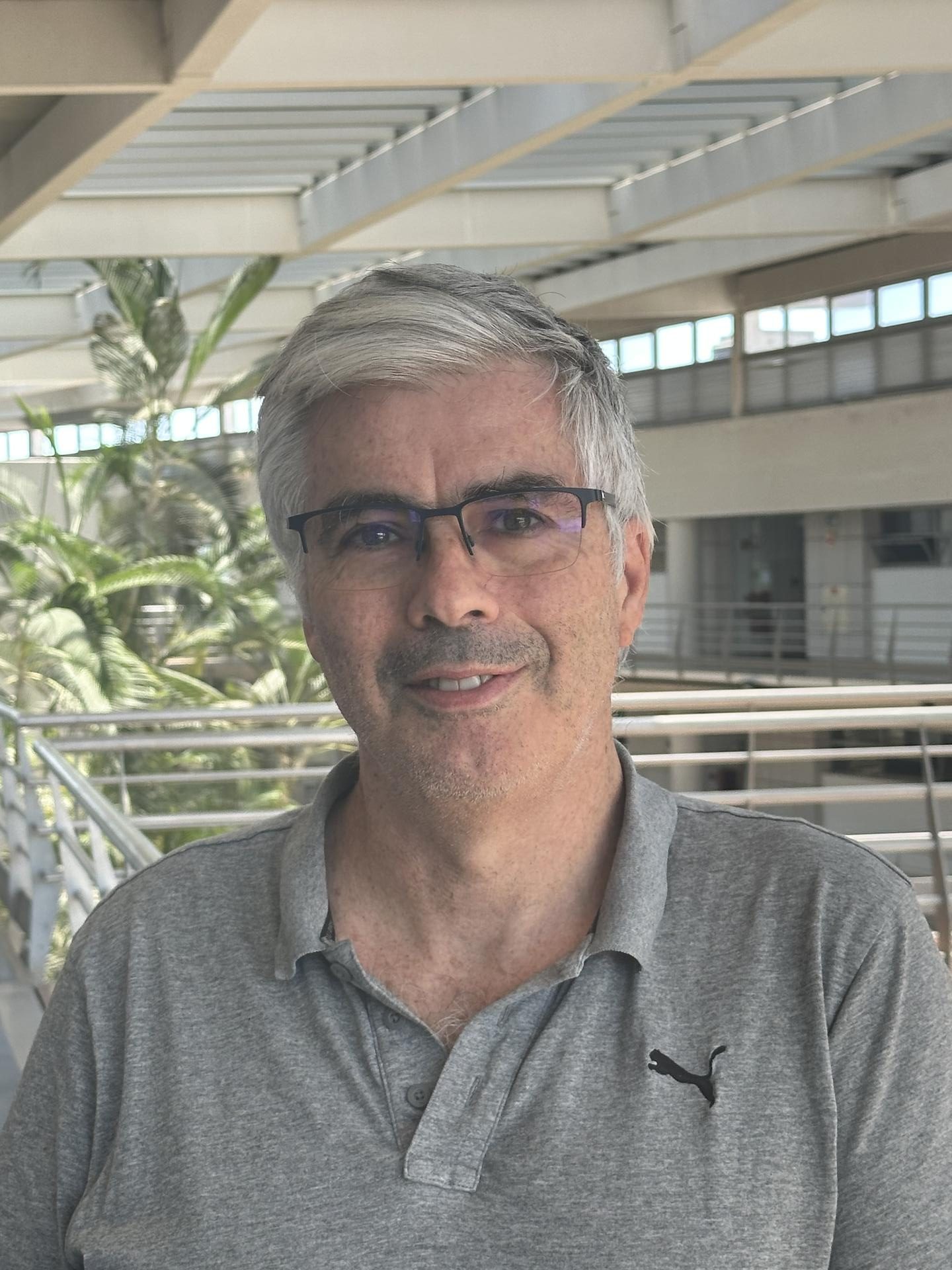
In this edition of Inside DEI, we will get to know Professor Pedro Sousa a little better.
- Tell us a bit about yourself and your journey at Técnico.
My connection to Técnico began in 1982, when I enrolled as a student in Electrical and Computer Engineering. At the time, there was still no Computer Science and Engineering degree at IST. I graduated in 1987 and, from that day on, I never truly left this place.
Even before finishing my degree, in 1985, I was already doing research at INESC, in the INESC Operating Systems Group, and in 1988 I became a Teaching Assistant at DEEC, teaching practical classes in Digital Systems, Microprocessors, and later, Operating Systems. My master’s degree, completed in 1991, was carried out in parallel with my participation in the COMANDOS project, a major ESPRIT contract in the area of persistent and distributed object systems. My PhD naturally followed from the work developed there. My postdoctoral period marked a turning point in my career, as DEI was being founded and there was both an opportunity and a gap in the field of Information Systems. I accepted the challenge of taking on that area. I also went on to lead the INESC Software Engineering Group, which accelerated this transition toward the field of Information Systems. In 2004, I became an Associate Professor.
I was responsible for DEI’s Non-Teaching Resources in 2005 and 2006, a role from which I have very fond memories, despite my struggles regarding SIADAP with the central administration.
I served on the DEI Executive Committee for three terms: from 2003 to 2005, from 2007 to 2008, and more recently between 2017 and 2019, during the final presidency of Prof. Alves Marques, where I was responsible for finances, spending much of my time securing funding for hiring teaching assistants.
In terms of courses, I will highlight only the core ones that still exist: the Databases course, which I took over very early on, and the courses that today correspond to Enterprise Architecture and Business Process Engineering and Technology. I believe these subjects are becoming increasingly relevant, particularly in the age of AI, because their conceptual and methodological components are completely technology-agnostic and more relevant than ever. Today, I have already passed responsibility for these courses on to younger colleagues. The last time I was in charge was for the Databases course, when it had 650 students...
Master’s supervision has also been a very important part of my relationship with IST, even more significant than teaching itself, because we get to know and work with students much more closely than in regular teaching. After supervising around a hundred master’s theses, I decided to take a break this semester...
- What does your teaching work currently consist of?
Currently, I teach in the three courses I mentioned — DB, EA, and BPET — largely depending on teaching needs. Whenever possible, even when I am the course coordinator, I choose to teach the practical classes because there is more interaction with the students.
- And in research?
The focus of my research for many years has been on the areas of Enterprise Architecture and Business Processes. These topics become increasingly relevant the easier it becomes to create applications and automations.
Since it is much, much easier to build something from scratch than to maintain and evolve what already exists, the code and applications that support organizations are constantly growing, and with that, complexity increases at an ever faster pace.
But the same problem also exists at the level of models. For example, in the domain of Processes, the process specification notation BPMN encapsulates the structure of an organization. Since organizations are constantly changing their structure, processes are always becoming outdated.
In the field of Enterprise Architecture, perhaps the main research topic is the minimization of the effort required to keep models updated in organizations that are in a state of permanent and accelerated change. My answer to this challenge lies in the concept of “Enterprise Cartography,” a term I proposed and which recently culminated in a book co-authored with André Vasconcelos.
- And in industry?
I have been working in industry since 1996, and it has been the driving force behind both my teaching and research. As early as 1998, I was responsible for a data model reengineering project in a company that had acquired a system with a database containing thousands of tables and later needed a conceptual data model. This was the first piece of research directly motivated by industry. It resulted in several papers, but it also had an immediate and profound impact on the Databases course. Even this year (2026), I raised several warnings in the Databases course about the relaxation of essential aspects of conceptual modeling.
In industry, I have made a point of working primarily in Enterprise Architecture and Business Processes. This makes it possible to bring real cases into the classroom, encourage master’s students to think critically about these topics, and take solutions back into industry. By now, this amounts to nearly a hundred Enterprise Architecture projects in national and international organizations, both public and private.
There are issues that appear very simple, but are in fact highly complex. For example, almost every organization needs to maintain a list of its applications. Yet, in the absence of objective criteria, that list may contain 300, 500, or 1,500 applications depending on who compiles it. Software engineering and standards define what a component is (the part), but not the whole. In 2012, I worked on a project at Caixa Geral de Depósitos concerning the definition of what constitutes an application, which resulted in a paper. In 2025, I once again worked on a project at Caixa Geral de Depósitos, as well as in two other major financial organizations, where the same issue resurfaced.
It is through industry that I have come to understand how fundamental the clarification of the functional and structural perspective is in everything we model and seek to understand. This cuts across all ways of thinking, whether in data modeling, process modeling, or organizational modeling.
Professionally, I began at INESC, but in 2000 I moved to Link, where I have remained as the head of the Enterprise Architecture area. I also served on Link’s management board, but management is not really my thing.
- Which projects from your career would you highlight? For example, the most inspiring, innovative, or impactful ones.
Without a doubt, the creation of an Enterprise Architecture and Cartography solution in which anyone can navigate through time across any model. All views include a timeline that allows navigation through the past, present, and expected future.
Applied to the city of Lisbon, it would be like a Google Maps where one could go back in time and see what the city looked like in the past, but also move forward in time and view on the map all the constructions already approved and scheduled to be built up to the selected date. Any change would consist of two lists: the things that are going to appear and the things that are going to disappear. For example, if we moved forward in time to December 2027, we would see today’s city enriched with everything planned to be built by that date, and without everything expected to disappear in the meantime.
Now, this same idea is applied to organizational models, fueled by the hundreds of projects that organizations undertake every year...
- What do you enjoy most about your day-to-day life at Técnico?
My physical presence at Técnico is almost exclusively limited to classes and to DEI on Wednesdays, since I do not have a fixed office. Meetings with fellow faculty members and master’s students are almost entirely remote.
There is a contradictory tension in teaching today: while it is discouraging when many students do not show up for classes, on the other hand, those who do attend often make it worthwhile.
But Técnico does not end at the door when I leave. It is present in almost everything I do professionally and sometimes manifests itself in unexpected ways: quite often, in meetings or projects, someone recognizes me as their former professor. Most of the time I do not remember them, but they remember me.
- Who is Pedro outside Técnico?
Outside Técnico, I live in Sintra, at the foot of the mountains. I prefer nature to the city, and whenever I can, it is to nature that I escape, whether for walks or for travel. A good meal and a good conversation, mixed with some debate, are two pleasures I do not give up.
I am naturally an early riser, which helps, because I am almost always busy, usually with work. This is not a complaint, it is an observation: I like what I do, and that comes with a cost in free time.
I have two children and, like any parent, that is where some of the best parts of life outside work are. In sports, I was an amateur runner for many years. After three knee surgeries, I switched from running to cycling.
If there is one thing that characterizes me outside Técnico, it is that Técnico rarely truly stays outside. The discussion of ideas is perhaps my main hobby and, at some point, almost always, Técnico enters the conversation. I am not sure whether that is a flaw or a blessing. Probably both.
(image: Pedro Sousa)