Wednesdays@DEI: Talks, 30-09-2026
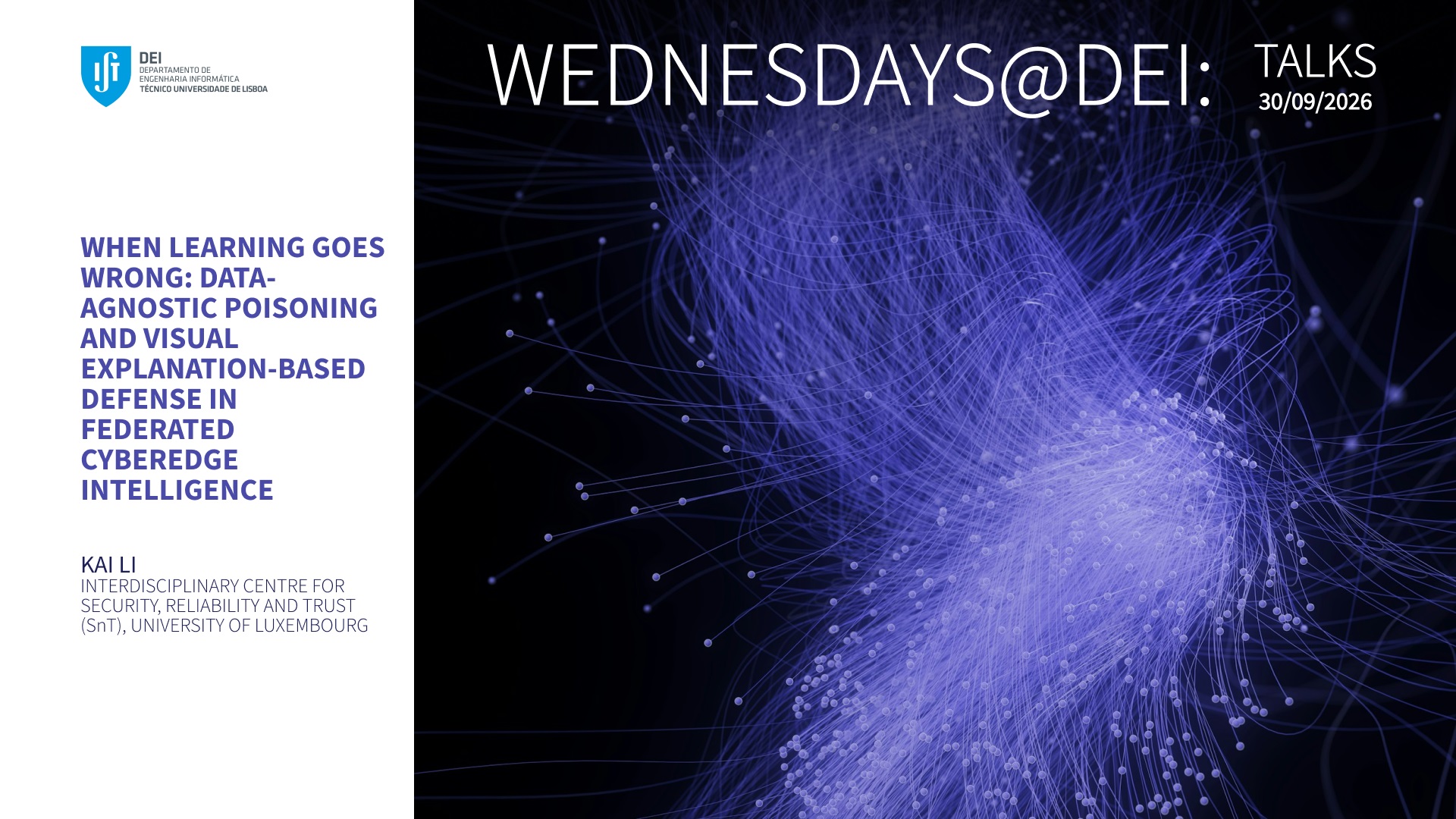
Title: When Learning Goes Wrong: Data-Agnostic Poisoning and Visual Explanation-based Defense in Federated CyberEdge Intelligence
Abstract: In CyberEdge networks, where federated learning (FL) orchestrates intelligence across privacy-preserving edge devices, emerging model poisoning (MP) poses a critical threat to system resilience. This talk focuses on a new type of the data-agnostic poisoning, where an adversarial variational graph autoencoder (VGAE) constructs malicious local model updates from benign updates, bypassing access to private training data. By extracting and regenerating high-order graph structural correlations among benign client models, the new VGAE-MP attack produces stealthy and effective poisoning that evades conventional detection and leads to a progressive degradation of global model accuracy. To counter such graph-driven, semantically aligned threats, we further present a visual explanation-based defense framework that transforms local updates into visual heat-map representations via Gradient-weighted Class Activation Mapping (GradCAM) and can enhance their separability through autoencoder-based feature projection. This approach exposes hidden discrepancies between benign and malicious updates that Euclidean distance/Cosine similarity-based defenses fail to capture. In addition, we discuss the escalating vulnerability of CyberEdge FL to advanced graph-based attacks as well as promising pathways toward more resilient and trustworthy distributed intelligence.
Speaker: Dr. Kai Li , The Interdisciplinary Centre for Security, Reliability and Trust (SnT), University of Luxembourg
Bio: Dr. Kai Li received the B.E. degree from Shandong University, China, in 2009, the M.S. degree from The Hong Kong University of Science and Technology, Hong Kong, in 2010, and the Ph.D. degree in computer science from the University of New South Wales, Sydney, Australia, in 2014. He is currently a Project Researcher with the Interdisciplinary Centre for Security, Reliability and Trust (SnT), University of Luxembourg. Funded by the CMU-Portugal Visiting Faculty and Researchers Program, Dr. Li was a Visiting Scholar with the Department of Electrical and Computer Engineering, College of Engineering, Carnegie Mellon University (CMU), Pittsburgh, PA, USA, from November to December 2025. From 2024 to 2025, he was a Visiting Research Scholar with the School of Electrical Engineering and Computer Science, TU Berlin, Germany. From 2016 to 2025, he was a Senior Research Scientist with the CISTER Research Centre, Porto, Portugal, and concurrently a CMU-Portugal Research Fellow, jointly supported by Carnegie Mellon University and the Foundation for Science and Technology (FCT), Lisbon, Portugal. From 2023 to 2024, he was a Visiting Research Scientist with the Department of Engineering, University of Cambridge, UK. In 2022, he was a Visiting Research Scholar with the CyLab Security and Privacy Institute at CMU. Prior to these, he was a Postdoctoral Research Fellow with the SUTD-MIT International Design Centre, Singapore University of Technology and Design (SUTD), Singapore, from 2014 to 2016. He was also a Visiting Research Assistant with the ICT Centre, CSIRO, Brisbane, Australia, from 2012 to 2013, and a Research Assistant with the Mobile Technologies Centre, The Chinese University of Hong Kong, from 2010 to 2011. He has served as an Associate Editor for several journals, including IEEE TRANSACTIONS ON NETWORK SCIENCE AND ENGINEERING since 2026, \textit{Internet of Things} (Elsevier) since 2024, \textit{Nature Computer Science} (Springer)