
Inside DEI - Ana Paiva
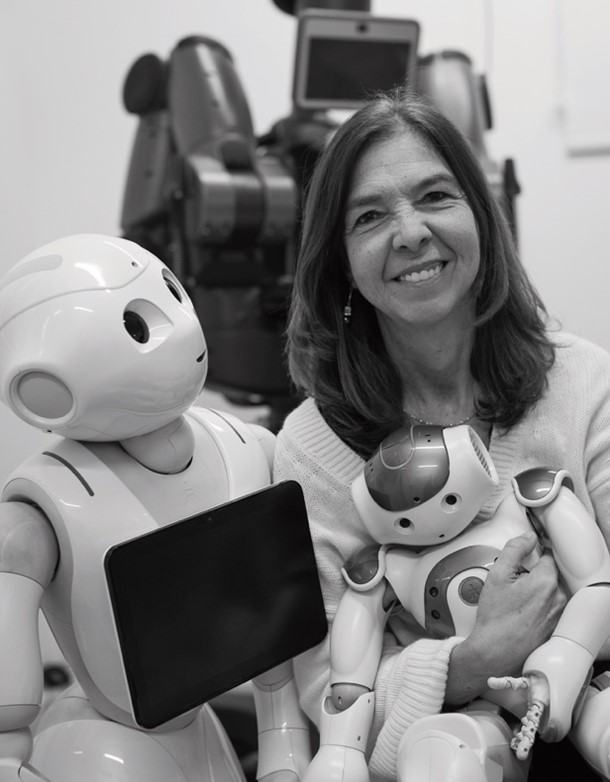
In this edition of Inside DEI, we will get to know Professor Ana Paiva a little better.
- Tell us a bit about yourself and your journey at Técnico.
I wanted to be an astronaut, and since I really enjoyed mathematics and physics, I decided to come to Técnico to study Electrical Engineering. At the time, I thought that a degree like Electrical Engineering would give me the skills to one day work with computers that could take us into space.
During my undergraduate and master’s studies, I stayed connected to teaching, working as a tutor, trainee assistant and assistant, and teaching foundational courses such as Numerical Methods (in the Department of Mathematics) and Introduction to Programming (in the Departments of Electrical and Computer Engineering, Mathematics, and Mechanical Engineering).
At the end of my undergraduate degree, I discovered the field of Artificial Intelligence (AI). At the time, I was an intern at INESC (in Professor Arroz’s group), and I completed my master’s under the supervision of Professor Helder Coelho, one of the pioneers of AI in Portugal, exploring AI in intelligent buildings. It was a period of discovery that led me to pack my bags and head to the United Kingdom to pursue a PhD. At a time when AI was facing major challenges and going through one of its well-known “winters,” I was often advised to change topics and choose a different research area. But the dream was stronger, and the fascination with uncovering aspects of the human mind, using them as inspiration to engineer and build an “artificial intelligence”, was something I did not give up on. I completed my PhD at the University of Lancaster, in the north of England, in the field of AI for Education, working on personalization problems, something we now almost take for granted in most systems.
When I returned in 1997, at a time when the Department of Computer Science and Engineering (DEI) was just beginning to take shape (the department was officially created in 1998), I joined the Artificial Intelligence area as an Assistant Professor. Since then, my entire path has been within DEI. I have served as Coordinator of the Master’s in Computer Science and Engineering (MEIC) at Taguspark and of the PhD in Computer Science and Engineering, and I was also Vice-President for postgraduate studies at DEI. I also had the honor of being part of Técnico’s Scientific Council and School Council, which helped me better understand and contribute to the institution as a whole.
In 2002, I moved to the Taguspark campus, when it was still under construction and there were building works everywhere, literally. In fact, the area next to my office had plastic sheets serving as walls, put there to keep out the rain and cold when we walked through the corridors. It was there, at Taguspark, that my group, GAIPS (Group of Artificial Intelligence for People and Society), developed and grew, becoming a research group in social AI with significant global impact.
I take great pride in belonging to Técnico, and every day I am impressed by the quality of our students, faculty, and staff. In particular, I am very proud of the results that we, at DEI, have achieved, from its beginnings in the late 1990s to the present day.
- What does your teaching work currently consist of?
Teaching is a central part of our work as professors. I see it not only as a space for sharing knowledge, but also as a way of constantly challenging the limits of my own understanding, confronting my own ignorance whenever I approach a new topic. To teach well, we must enjoy learning and recognize that we need to do so continuously. Classes, and students, whether undergraduate, master’s or PhD are the main reason we are always learning.
I began my teaching career at a very young age, as a tutor while I was still an undergraduate student, and it was an incredible experience. In the early years, I taught Numerical Methods and Introduction to Programming, where I taught Pascal. When I returned from my PhD, after several years in the United Kingdom, I had the freedom to create new courses, such as Autonomous Agents and Multiagent Systems, a course that has now gained renewed relevance with the rise of generative AI. I have taught a wide range of courses across different areas within DEI, including Introduction to Programming, Programming Fundamentals, Object-Oriented Programming, and Computing and Society. The latter was particularly rewarding to teach, as one of its goals was to help students understand the broader implications of AI, including its social and ethical consequences. Since AI is my main area, it is where I have focused most of my teaching. I have coordinated and taught courses such as Logic Programming, Artificial Intelligence, Logic for Programming, Autonomous Agents and Multiagent Systems, and Affective Computing. In addition to these, and following a sabbatical at CMU, I launched a new course in Social Robotics and Human–Robot Interaction, which has been running ever since and which, I believe, will be increasingly important in the future, given the potential of AI to revolutionize robotics.
At a time when AI is reshaping the way we learn, it is up to us to explore new ways of using technology in teaching and learning, leveraging its potential while ensuring that students acquire the critical skills they need for their future.
- And in research?
After completing my PhD, when I returned to IST and INESC, I founded GAIPS (Group on AI for People and Society), focusing on the areas of Autonomous Agents and Social and Collaborative Artificial Intelligence. The challenge was, and continues to be, to create artificial systems capable of perceiving, interpreting, and acting appropriately in response to human social signals and collaborating with people effectively.
Over the years, I have had the privilege of supervising numerous PhD students and researchers, many of whom now hold prominent positions in leading universities and research centers worldwide. Without them, my research would have been far more limited. This collective journey in building knowledge is one of the most impactful aspects of our work, as it contributes to the advancement of the field on a global scale.
I have also experienced particularly meaningful moments in my research career. One of them was my fellowship at the Radcliffe Institute for Advanced Study at Harvard University, which provided an exceptional interdisciplinary environment to question the social dimensions of AI and to shape an area I named “prosocial computing.” This period of reflection helped consolidate a broader vision of AI’s impact on society, reinforcing the importance of integrating perspectives from the social sciences and the humanities into technological development.
Another important moment for me was delivering a keynote at IJCAI in 2022, titled “Engineering sociality and collaboration in AI systems.” IJCAI is one of the leading international conferences in AI, attracting thousands of participants, and it was one of the first conferences I attended as a master’s student. It was there that I first saw figures such as John McCarthy, Rodney Brooks, Marvin Minsky, and many others. So, when I was invited in 2022 to give one of the keynotes at IJCAI in Vienna, it was a moment of great pride and responsibility. My talk reflected the maturation of many years of research dedicated to engineering cooperation and sociality in agents. This progress was the result of the work of all the students and faculty at GAIPS, without whom this keynote would never have happened.
- Which projects from your career would you highlight? For example, the most inspiring, innovative, or impactful ones.
Throughout my career, I have had the opportunity to lead and participate in more than three dozen national and European projects that have helped consolidate the field of socially intelligent agents, and in particular contributed to the growth of GAIPS.
I would highlight, for example, the VICTEC and E-circus projects, both coordinated by Professor Ruth Aylett from Heriot-Watt University in Edinburgh, with whom I have collaborated for over two decades. In these projects, we developed intelligent agents in virtual worlds aimed at helping children who are victims of bullying. These projects were particularly significant in demonstrating, in a concrete way, how AI and agents can be used to foster social and emotional skills in sensitive educational contexts.
I also coordinated the European project Safira, one of the first projects funded by the European Commission in the field of affective computing, at a time when the study of emotions in artificial systems was still emerging. This project played an important role in establishing a scientific agenda that is now central to human–AI interaction.
Another project that was especially meaningful to me was LIREC (Living with Robots and Interactive Companions), also funded by the European Commission, where we explored the development of agents and robots capable of establishing long-term relationships with humans, addressing fundamental challenges of sustained social interaction. It was during this time that we began working with social robots, which allowed us to explore how the “bodies” of agents influence interactions with humans, particularly when these interactions unfold over long periods.
More recently, I have been involved in European networks in the field of AI, such as HumanE-AI-Net and TAILOR, where we worked on building an integrated, human-centered vision of AI. In particular, the TAILOR project, whose work focused on trustworthy and responsible AI, and where I coordinated one of its work packages, contributed significantly to the design of technologies for a future in which we can place trust in AI.
- What do you enjoy most about your day-to-day life at Técnico?
I enjoy the sense of freedom to research what I like. I enjoy being able to read the papers that interest me, to buy a book in a different area, to imagine and build connections with other fields, and to feel that I contribute to knowledge, not only my own, but also that of those around me. I especially value the interaction with students, the exchange of ideas, and helping them not to be afraid to explore, to innovate, to create start-ups, in short, to pursue their dreams.
No two days are ever the same. There is always something new happening: a new proposal to write; a new class that needs fresh slides; a new paper that must be read and reviewed; a report that has to be submitted; a meeting to discuss a new collaboration or student work to assess.
This diversity of tasks makes our days full and far from monotonous, making the work both demanding and deeply motivating.
- Who is Ana outside Técnico?
Outside Técnico, I am very family-oriented. I love cooking, going to the beach, traveling, reading and doing nothing at all. Spending an afternoon in the garden reading is a privilege I truly value, and fortunately, I manage to do it from time to time.
I also greatly enjoy political debate and studying public policy, particularly in the area of science. This was especially valuable during the period when I served in government as Secretary of State for Science. For me, as a scientist and professor, being able to contribute to improving science in Portugal is something I have had the great honor to be part of.
(image: Ana Paiva)