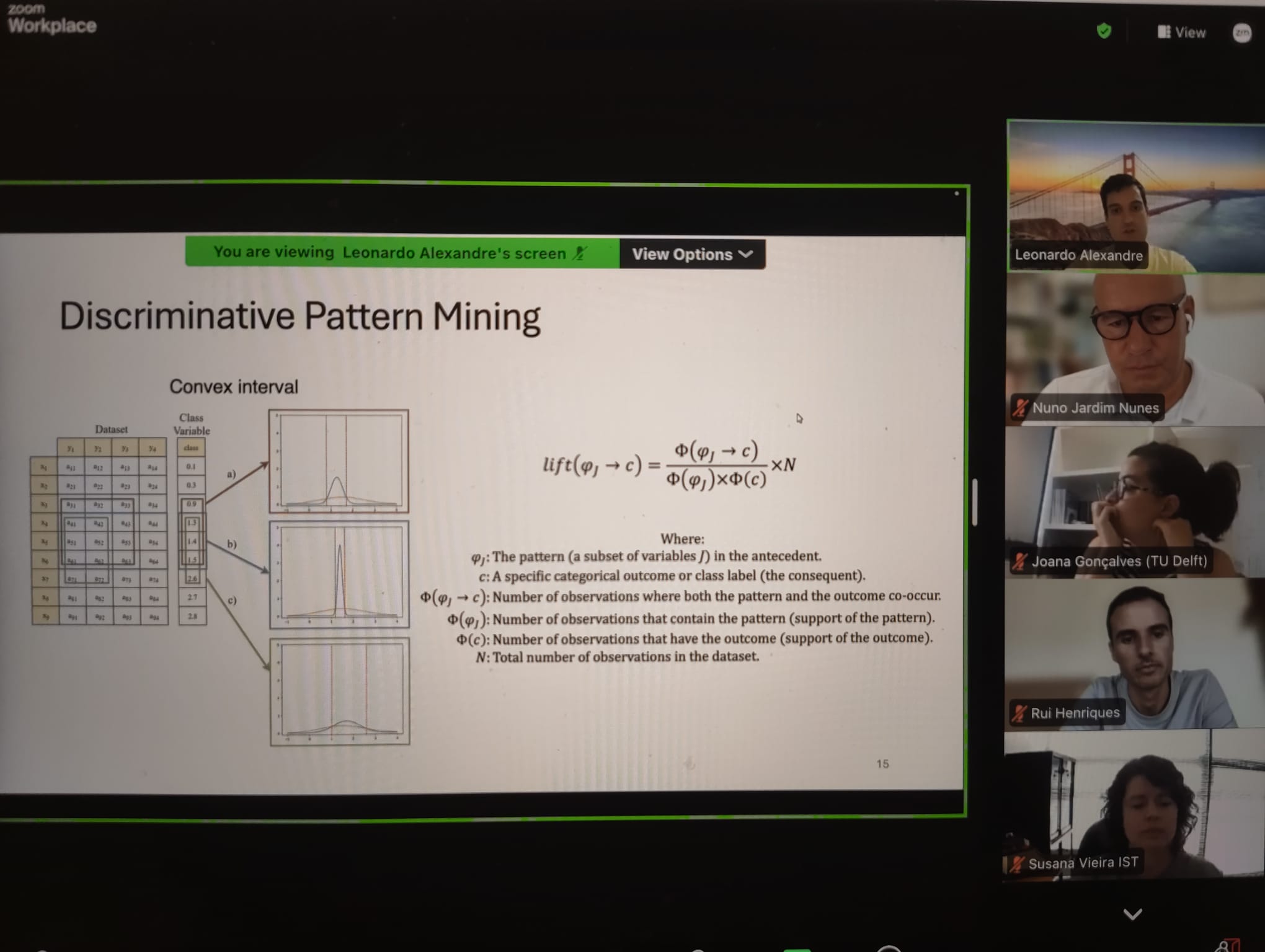
Prova de Doutoramento do aluno Leonardo Duarte Rodrigues Alexandre

Área: Engenharia Informática e de Computadores
Título da Tese: Pattern Discovery: Addressing Long-Standing Barriers
Local da Prova: https://tecnico-pt.zoom.us/j/99230485584
Data: 03/07/2026
Hora: 10h00
Abstract: Pattern discovery is at the core of notable advances, specifically in biomedical domains where it is used to unravel regulatory mechanisms and disease progression profiles. In the context of tabular data, patterns are local regularities satisfying predefined criteria. In recent years, the emergence of tensor data structures (e.g. multivariate time series) allowed researchers to focus on more expressive patterns, such as multivariate trajectories within three-way time series data. The field of pattern discovery has received numerous contributions, however, several key challenges remain underdeveloped, mainly: i) dealing with heterogeneous data, ii) handling numeric targets, iii) mitigating false discoveries, iv) increasing the scalability of pattern mining algorithms, and v) including custom criteria to guide pattern discovery. This thesis introduces methodologies designed to address the five aforementioned challenges, specifically, proposing a novel discretization approach, extending classical pattern evaluation through statistical modeling, establishing statistical principles needed for evaluating patterns in tensor data, defining similarity criteria that accommodate different pattern types to guide the partitioning of data, and, defining an unified pattern discovery framework. Validation is undertaken using real-world data from social, biotechnological, and medical domains. Complementarily, pattern discovery in psychiatry is selected as a guiding case study. The etiology of mental disorders is vastly studied, however, still poorly understood. In this context, the generalization and actionability of discovered knowledge is hampered by the heterogeneity and overlap of symptoms. Traditional trajectory analysis methods (e.g., growth mixture modeling) in longitudinal studies often assume homogeneous patterns across all patients, whereas emerging pattern mining approaches may uncover distinct temporal subpopulation patterns, crucial for personalized medicine and targeted interventions. To this end, the proposed pattern discovery principles are applied for acquiring novel knowledge from longitudinal and/or multimodal data, guiding neuropsychiatric research and translation medicine.